Use the Power of Perspective to Create Realistic Space in Your Art!
Have you ever noticed how some drawings feel like you could step right into them? That sense of space and realism comes from perspective. Perspective is what helps artists show depth, distance, and scale on a flat surface, turning a simple drawing into a believable world.
At its core, perspective is about how things appear to our eyes. Objects that are closer look larger and more detailed, while objects farther away appear smaller and less defined. By understanding and practicing perspective, artists can create artwork that feels three-dimensional and full of life.
Linear Perspective: Using Lines to Show Depth
Linear perspective uses lines and vanishing points to create the illusion of space. You’ve probably seen this in drawings of roads, hallways, or city streets where parallel lines seem to meet in the distance. That meeting point is called a vanishing point, and it sits on the horizon line, which represents the viewer’s eye level.
In one-point perspective, all lines move toward a single vanishing point, which is great for scenes viewed straight on, like a road or railroad tracks. Two-point perspective uses two vanishing points, and it is often used for buildings viewed at an angle. These systems help artists keep objects proportional and make spaces feel more structured and realistic.
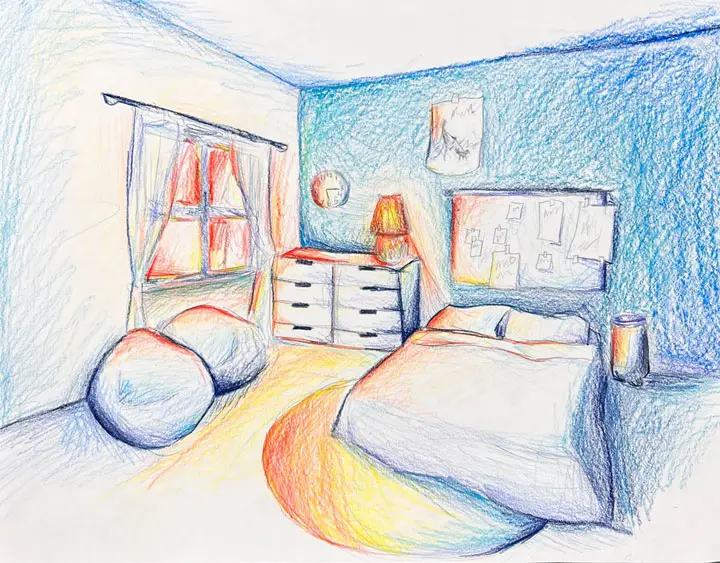
One of our teen students used Two-Point Perspective to create this warm and cozy interior bedroom scene. This is an example of how vanishing points can be very subtle; this student's vanishing points are far off the page, but everything still connects to the same imaginary points.
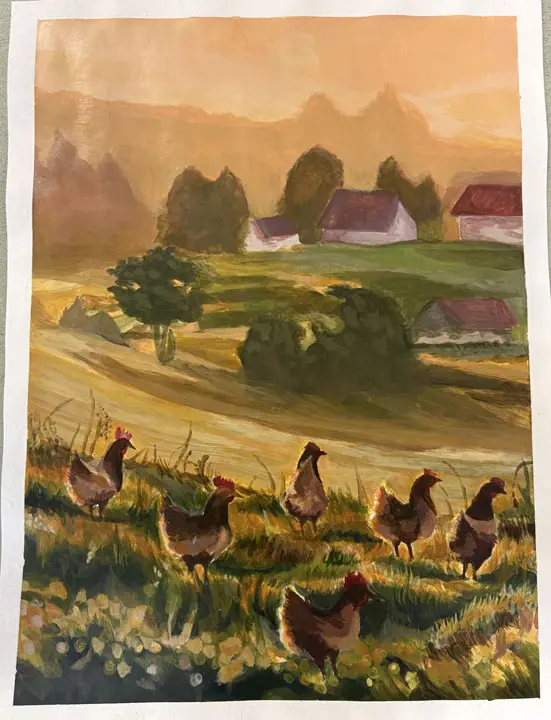
In this rustic landscape painting, a teen student uses Atmospheric Perspective to convey realistic depth. While the chickens in the foreground are very detailed, the subjects appear more and more simple and hazy as they disappear into the background.
Atmospheric Perspective: Creating Depth with Value and Color
Not all perspectives rely on lines. Atmospheric perspective shows depth by using changes in value, color, and detail. Objects in the distance tend to look lighter, softer, and less detailed, while closer objects appear darker, sharper, and more vivid.
You can see atmospheric perspective in landscapes, where faraway mountains look pale and hazy compared to detailed trees in the foreground. Artists use this technique to suggest distance and create a sense of atmosphere, even without strict perspective lines.
Tips for Creating More Realistic Perspective
Start simple: Lightly sketch horizon lines, vanishing points, or basic shapes before adding details.
Think in scale: Make nearby objects larger and more detailed, and reduce size and detail as objects move farther away.
Use overlap: When one object overlaps another, it instantly feels closer to the viewer.
Watch your values: Strong contrast in the foreground and softer values in the background help create depth.
Observe real life: Look at roads, buildings, and landscapes around you and notice how size, color, and clarity change with distance.
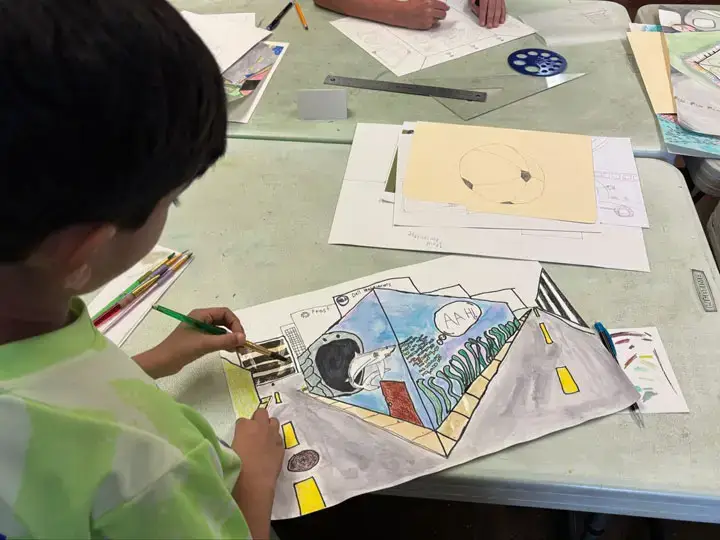
This young student uses Two-Point Perspective to create a realistic building viewed from a street-corner. You can see the two vanishing points he uses on either side of the drawing to connect all of his lines to.
Bringing It All Together
Perspective is one of the most powerful tools an artist can learn. Whether you’re using linear perspective with vanishing points or atmospheric perspective with soft colors and values, these techniques help your artwork feel grounded and believable. With practice, perspective becomes less about rules and more about seeing the world like an artist—full of depth, space, and endless creative possibilities.