You Can Draw Anything! How to Use Simple Shapes in Your Art
No matter your age or skill level, every drawing begins the same way — with simple shapes. Circles, squares, triangles, and ovals are the building blocks of everything you see. Once you learn to spot these forms, drawing becomes less about guessing and more about understanding.
Why Simple Shapes Work
When you look at a complex object, it can be overwhelming to figure out where to start. Breaking it down into basic shapes will help you see the structure beneath the details.
A cat’s head becomes a circle, the body an oval, and the ears triangles. A car is a mix of rectangles and curved shapes. A tree can start as a tall rectangle for the trunk and a large oval for the leaves.
Thinking this way helps you build accurate proportions and balance — and keeps your drawing from getting confusing too soon.
Helpful Tips
Sketch Lightly Use gentle lines when you begin. These shapes are guides, not the final drawing. You’ll refine them later, so keep your pencil marks soft and easy to erase.
Look for Overlaps and Angles Notice where shapes overlap or connect. For example, the head and shoulders of a person aren’t side by side — the head overlaps slightly on top. Paying attention to how shapes line up helps your drawing look more natural.
Simplify Before You Add Detail Don’t rush into textures or shading. Make sure your basic shapes look right first. A strong foundation will make the finished drawing look solid and believable.
Use Shapes to Guide Perspective Boxes, cylinders, and spheres are great for showing depth. When you draw something at an angle — like a cup or car — start with a 3D shape to keep it realistic.
Practice Seeing Shapes Everywhere Challenge yourself to find the shapes in everyday objects — a lamp, a shoe, even your hand. The more you do this, the easier it becomes to draw from life.
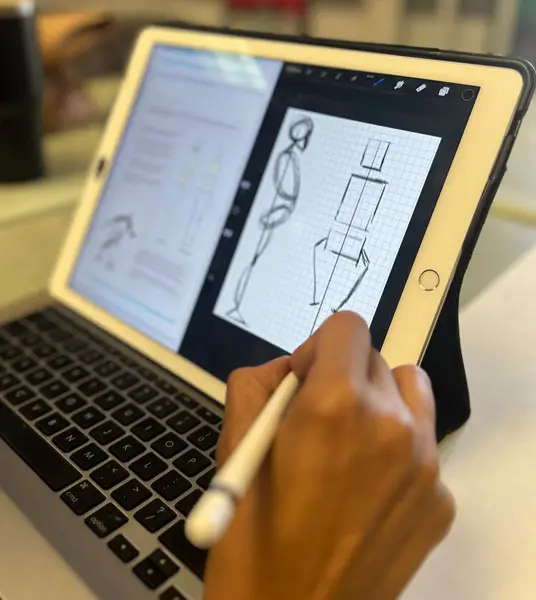
Simple shapes are the building blocks of any drawing—even the most complex ones! This adult student is using squares, rectangles, and guiding lines to plan the proportions and pose of a human figure, showing how every great artwork begins with basic forms.
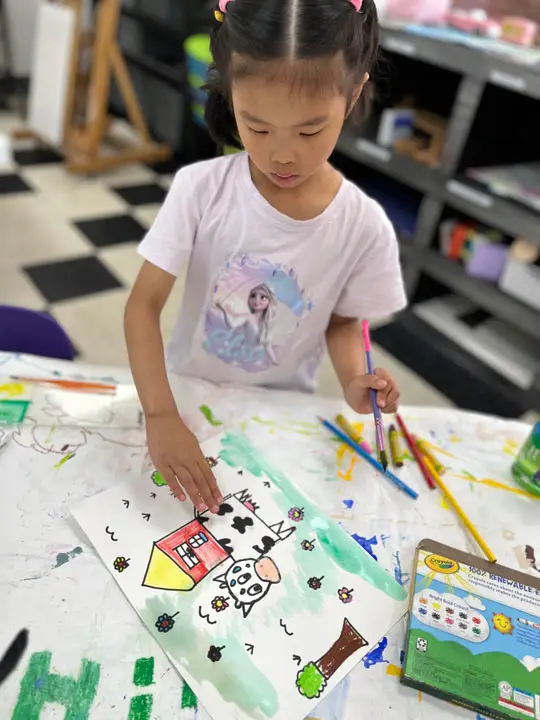
A 5 year-old student explores how simple shapes can build a complete picture! She used a square for her cow’s body, a circle for the head, and triangles for the legs. In the background, she combined squares, triangles, and rectangles to create a farmhouse—proof that every drawing starts with shapes!
THINGS TO AVOID
Pressing too hard too soon. Heavy lines are hard to change and make your drawing stiff.
Skipping the structure. Jumping straight into details can lead to poor proportions and frustration.
Forgetting perspective. Even simple shapes need to follow the same angle or viewpoint to look right together.
Getting stuck on perfection. Shapes are just a tool — they don’t have to be exact. Use them to find your drawing, not to make it mechanical.
Final Thought
Starting with simple shapes is one of the oldest drawing methods — and one of the most effective. It helps children learn structure and gives experienced artists a way to plan complex scenes. Whether you’re sketching a flower or designing a figure, every masterpiece begins the same way: with a few light shapes on the page.
With practice and patience, those simple circles and squares can transform into anything you can imagine.